Weber County Dog Registration Information
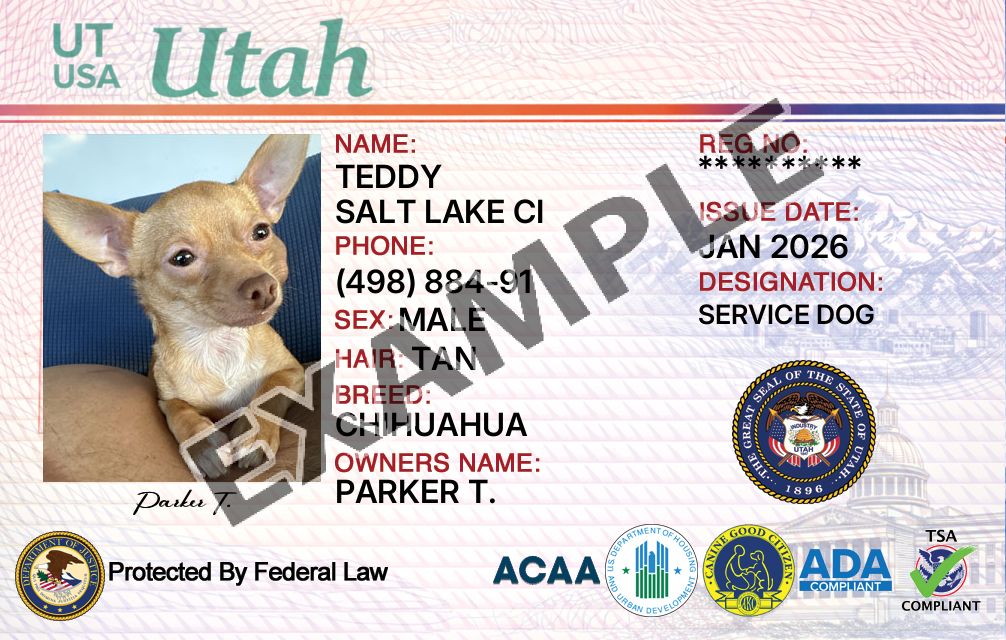
Service Dogs and Emotional Support Animals in Weber, Utah
If you’re searching where do I register my dog in Weber County, Utah for my service dog or emotional support dog, the key thing to know is that most residents are really looking for two different processes: (1) getting a dog license in Weber County, Utah (a local requirement tied to rabies vaccination and local ordinances), and (2) understanding what makes a dog a service dog or an emotional support animal (ESA) under the law. Dog licensing is handled locally (county or city). Service dogs and ESAs are not “registered” through one universal federal registry.
Where to Register or License Your Dog in Weber County, Utah
The offices below are official local government contacts that serve Weber County residents for animal services and/or dog licensing. Because requirements can vary by municipality, start with the office that serves your city of residence (or Weber County Animal Services if you are in an unincorporated area or a participating city).
Weber County Animal Services (Weber County Animal Shelter)
- Phone (Office / Recorded Messages): 801-399-8244
- Phone (Animal Control Officers): 801-399-8246
- Non-Emergency Dispatch (report problems such as stray animals): 801-395-8221
- Email: animalservices@webercountyutah.gov
- Hours: Monday–Friday 1:00 p.m. to 5:30 p.m.; Saturday (adoptions only) 12:00 p.m. to 4:00 p.m.; Closed Sunday
Ogden City Animal Services (Animal Control)
- Phone: 801-629-8244
Riverdale City Civic Center (Dog Licensing) / Riverdale City Animal Control
- Phone (Animal Control): 801-394-6616
- Phone (Civic Center): 801-394-5541
- Hours (for dog licensing at Civic Center): Monday–Friday 8:00 a.m. to 5:00 p.m.
Note: Other Weber County municipalities may provide their own animal control and/or dog licensing (for example, North Ogden City, Roy City, South Ogden City, Pleasant View City, and Washington Terrace). If you live in one of those cities, contact your city’s animal control or licensing office for the correct registration process for that municipality.
Overview of Dog Licensing in Weber County, Utah
Dog licensing is a local requirement
A dog license is a local registration record maintained by a county or city. In practice, “where to register a dog in Weber County, Utah” usually means “where do I obtain or renew my dog’s license tag.” Licensing helps local animal services:
- Confirm rabies vaccination status
- Return lost dogs to their owners faster (through tags and records)
- Support animal control and shelter operations
- Enforce local pet ordinances (leash rules, nuisance complaints, etc.)
County vs. city licensing inside Weber County
Weber County includes multiple cities, and dog licensing requirements in Weber County, Utah can differ depending on your address. Some residents license through Weber County Animal Services, while others license through their city (and may have city-specific forms, fees, and renewal deadlines).
If you are unsure which agency applies to you, start with Weber County Animal Services and tell them your street address and city. They can often confirm whether you should license through the county or through your municipality’s animal control.
What You Need Before Registering a Dog
Common documents and information
Most licensing offices will ask for documentation that proves your dog meets minimum health and identification requirements. While specifics can vary by city, the most common items include:
- Rabies vaccination proof (often required for a license)
- Spay/neuter documentation (if applicable; may affect licensing fees in some areas)
- Owner identification (a driver license or other ID may be requested)
- Proof of residency in the relevant city/county service area (sometimes requested)
- Payment method accepted by the local office (varies by office)
Service dog or ESA paperwork: what matters locally
A dog can be a service dog or ESA and still need a local license. Licensing offices typically focus on rabies vaccination and local ordinance compliance, not on “registering” the dog as a service animal. If you have accommodation-related documentation (for example, an ESA letter for housing), keep it for the appropriate context (housing provider), but don’t assume it replaces the need for a dog license.
Steps to Register or License a Dog in Weber County, Utah
Step 1: Identify the correct licensing office for your address
To avoid delays, confirm whether your dog should be licensed through:
- Weber County Animal Services (often for unincorporated Weber County and certain participating cities)
- Your city’s animal control/licensing office (some municipalities handle their own licensing)
Step 2: Gather vaccination and sterilization records
Have a current rabies vaccination certificate available. If your dog is spayed/neutered, keep that documentation handy as well, since it may be requested or may affect the fee category.
Step 3: Apply in person, by mail, or renew using the method your office allows
Some agencies require first-time licenses to be handled in person or by mail, and allow online renewal only. Procedures can change, so call ahead if you have questions about:
- Whether new licenses must be started in person
- Whether you can renew remotely
- Accepted payment types
- When tags are issued and how they are delivered
Step 4: Keep the license tag on your dog’s collar
Once issued, attach the license tag to your dog’s collar as directed by your local agency. This is one of the simplest ways to help animal control return a found dog quickly.
Service Dog Laws in Weber County, Utah
Service dogs are not “licensed” as service dogs by one universal registry
A service dog’s legal status is based on what the dog is trained to do for a person with a disability (task-trained assistance). There is no single federal government database that you must use to register a service dog. In everyday terms:
- Service dog status comes from training and disability-related tasks, not from buying an ID card or registering online.
- Local dog licensing is still typically required, even for a service dog, because it relates to rabies vaccination and local ordinances.
Public access vs. local licensing
Public access rights and rules for service dogs are separate from whether a dog has a local license tag. A license tag is a local compliance item; public access depends on the dog being a legitimate service dog and being under control in public settings.
Quick comparison (license vs. service dog vs. ESA)
| Category | What it is | Who issues it | Typical proof | Where it applies |
|---|---|---|---|---|
| Dog License | Local registration for dogs tied to local ordinances and rabies vaccination compliance | County or city animal services / animal control | Rabies vaccination certificate; sometimes spay/neuter documentation and owner info | Within the licensing jurisdiction (city/county) |
| Service Dog | A dog trained to perform tasks for a person with a disability | No single universal federal registry; status is based on training and disability-related need | Task training and appropriate behavior; documentation is not universally required for public access | Public access in many settings when the dog is a legitimate service dog and under control |
| Emotional Support Animal (ESA) | An animal that provides emotional support that alleviates symptoms of a disability (commonly in housing context) | No universal registry; housing-related documentation is typically from a licensed healthcare professional when appropriate | ESA letter/documentation for housing accommodations (context-specific) | Mainly housing-related accommodations; generally not the same public access rights as service dogs |
Emotional Support Animal Rules in Weber County, Utah
ESAs are different from service dogs
An emotional support animal (ESA) can be very important for a person’s well-being, but it is not the same as a task-trained service dog. In general:
- ESAs are most commonly relevant for housing accommodations, not general public access.
- A local government office that issues a dog license is usually not “registering” your dog as an ESA.
- Your dog may still need a dog license in Weber County, Utah (or in your city) even if it is an ESA.
How ESAs relate to licensing
From a licensing standpoint, ESAs are typically treated like any other dog: local rules may require rabies vaccination and a license tag, and may require renewal on a schedule set by your city or county. If you have questions about any fee categories or documentation your city requires, call your local licensing office.
Frequently Asked Questions
Do I need to license a service dog in Weber County, Utah?
Usually, yes. A service dog may still be subject to local licensing requirements (often tied to rabies vaccination and local ordinances). Contact the correct city or county licensing office for your address to confirm current rules.
Is there an official federal registry where I register my service dog or emotional support animal?
There is no single universal federal government registry that you must use to “register” a service dog or ESA. Local dog licensing is separate from service dog or ESA status.
What’s the difference between “animal control dog license Weber County, Utah” and a service dog ID?
An animal control (or animal services) dog license is a local registration tied to rabies vaccination and local ordinances. A “service dog ID” is not the basis of service dog status; service dog status is based on disability-related task training and appropriate behavior.
I live in a Weber County city—should I go to the county or the city?
It depends on the municipality. Some cities provide their own licensing and animal control, while other areas use Weber County Animal Services. If you’re unsure, call Weber County Animal Services and ask which agency handles licensing for your specific address.
What do I need to bring to get a license?
Commonly required items include proof of rabies vaccination and, if applicable, spay/neuter documentation. Some offices may also request identification, proof of residency, and payment in an accepted method.
What You May Need
-
Proof of rabies vaccination
-
Proof of residency (if requested)
-
Identification
-
Spay or neuter documentation (if applicable)
-
Payment for licensing fee (method varies by office)
Disclaimer
Local laws, fees, office locations, and contact details can change. Residents should verify the most current information with their local animal services or licensing office in Weber County, Utah.
Register A Dog In Other Utah Counties
Select your county below to get started with your dog’s ID card. Requirements and license designs may vary by county, so choose your location to see the correct options and complete your pup’s registration.
- Beaver County Dog Registration
- Box Elder County Dog Registration
- Cache County Dog Registration
- Carbon County Dog Registration
- Daggett County Dog Registration
- Davis County Dog Registration
- Duchesne County Dog Registration
- Emery County Dog Registration
- Garfield County Dog Registration
- Grand County Dog Registration
- Iron County Dog Registration
- Juab County Dog Registration
- Kane County Dog Registration
- Millard County Dog Registration
- Morgan County Dog Registration
- Piute County Dog Registration
- Rich County Dog Registration
- Salt Lake County Dog Registration
- San Juan County Dog Registration
- Sanpete County Dog Registration
- Sevier County Dog Registration
- Summit County Dog Registration
- Tooele County Dog Registration
- Uintah County Dog Registration
- Utah County Dog Registration
- Wasatch County Dog Registration
- Washington County Dog Registration
- Wayne County Dog Registration